
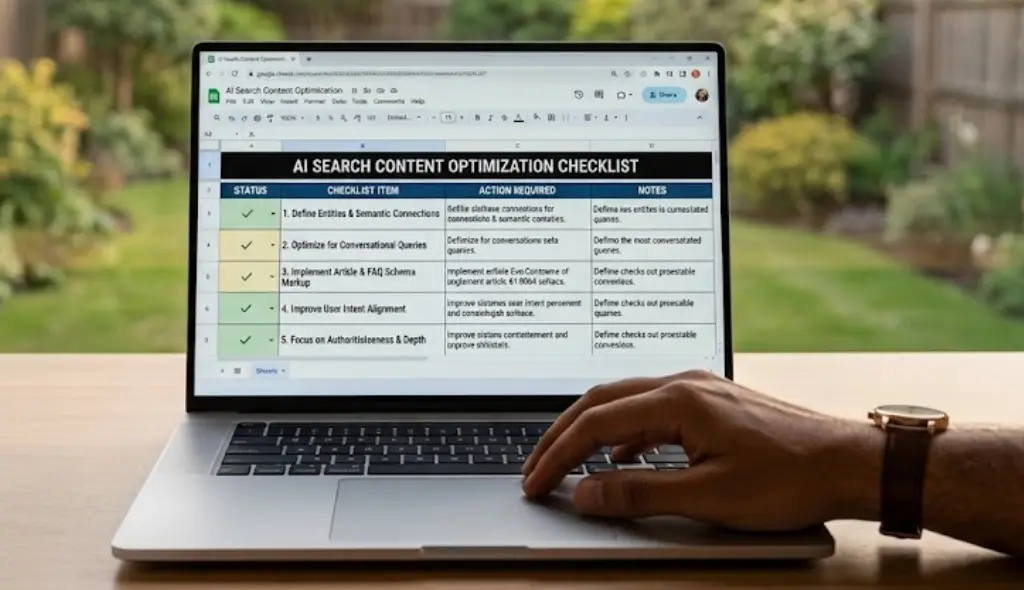
People now use ChatGPT, Google AI Overviews, Perplexity, Gemini, Claude, and Copilot to find answers. Before publishing, review your content for clear answers, reliable evidence, complete coverage, useful structure, and visible trust signals.
A strong Google ranking alone does not guarantee visibility in AI-generated results. This 10-step checklist helps you identify weak claims, missing context, technical barriers, and credibility gaps before the page goes live.
Why You Need an AI Search Content Optimization Checklist
Traditional SEO reviews often focus on keywords, metadata, internal links, and organic visibility. Content prepared for modern search also needs to explain the subject clearly, provide verifiable information, and address the questions that matter to the audience.
A pre-publish checklist helps uncover vague answers, missing context, weak structure, and trust issues before they reduce visibility. It also gives editors a consistent way to confirm that each page is useful, complete, and easy to interpret.
10-Step AI Search Content Optimization Checklist
Use these checks to strengthen the page’s usefulness, accuracy, and readability before it goes live. Each step helps readers find dependable answers while making the material easier for AI systems to interpret.
1. Answer the Main Question Immediately
Give readers the essential answer near the beginning. A focused opening helps visitors confirm that they have found the right page and creates a clear passage that can be understood without reading a long introduction.
Once the answer is established, expand with details, reasoning, and examples. Remove lengthy introductions that delay the information visitors came to find.
Quick Check: Can someone understand the central answer from the opening section?
2. Cover the Topic Completely
A useful page addresses more than the obvious question. Include related queries, meaningful comparisons, practical examples, common concerns, and any subtopics needed to make an informed decision.
Review competing pages and search results to identify gaps, but do not copy their structure. Look for unanswered questions where your expertise can add something new.
Quick Check: Would readers need another page to understand an essential part of the subject?
3. Make Your Content Easy to Scan
Good formatting lets visitors locate relevant details quickly. Clear sections separate ideas, helping readers follow the explanation and find relevant details quickly.
A well-structured page should include:
- Clear H2 headings
- Helpful H3 headings
- Short paragraphs
- Lists for actionable points
- Tables where comparisons are useful
Quick Check: Can readers find the section they need within a few seconds?
4. Add First-Hand Experience and Original Evidence
Original evidence gives readers a reason to trust your recommendations. Explain what you tested, how the work was completed, what you observed, and where the findings may not apply.
For example, an SEO editor reviewing article introductions could record the original opening, the revised answer-first version, and the change in clicks or engagement after publication. Include verified screenshots, dates, page samples, and results rather than making a broad claim such as “this method improves rankings.”
Quick Check: Have I shown how I reached this advice, or have I only repeated common recommendations?
5. Support Important Claims with Trustworthy Sources
Evidence makes technical and factual statements easier to trust. Link to official documentation, credible research, established industry reports, or the original source of a statistic.
Check publication dates, methodology, and context before referencing data. Reliable citations help readers verify the information and reduce the risk of inaccurate claims being repeated elsewhere.
For example, a statement about eligibility for Google AI Overviews should link to Google Search Central documentation rather than a software company summarizing Google’s requirements. When citing research, link to the original study instead of an article that mentions it.
Quick Check: Can every significant factual statement be verified through a dependable source?
6. Use Precise Terms and Meaningful Context
Specific names, products, organizations, technologies, and concepts can clarify how the subject fits together. Include them when they help the reader understand an important relationship, comparison, or process.
Content optimization tools such as Surfer SEO, Frase, Clearscope, or NeuronWriter may reveal terms used across competing pages. Treat these suggestions as research prompts rather than required phrases, because relevance matters more than including every recommended term.
Quick Check: Does each specialist term improve understanding, or was it added only because a tool suggested it?
7. Add Helpful Internal Links
Connect the page with supporting resources that explain related topics in greater depth. Relevant internal links improve navigation, reinforce subject coverage, and reveal relationships across your website.
For example, an article about AI content optimization could link to separate guides on structured data, content audits, and author credibility. Choose descriptive anchor text so readers know what they will find after clicking.
Quick Check: Does each internal link help the visitor take a logical next step?
8. Use Images That Improve Understanding
Visuals should clarify the written explanation rather than decorate the page. Original screenshots, labeled diagrams, and process illustrations can make complex instructions easier to follow.
Use descriptive filenames and accurate alt text that explains what the image shows. Avoid inserting keywords that do not match the visual.
Images should:
- Support the surrounding content
- Explain difficult ideas
- Include descriptive alt text
- Remain directly relevant to the subject
Quick Check: Would removing an image make the explanation less useful?
9. Show Readers Why They Can Trust the Page
Trust signals should help visitors verify who created the content, how it was prepared, and whether the information is still dependable. Include an accurate byline, a relevant author biography, a meaningful review date, and links to the sources used.
A short methodology note can strengthen experience and transparency. For example:
Written by Olivia Harper, an SEO strategist specializing in content audits and on-page optimization. This checklist was reviewed against Google Search Central guidance and applied during editorial reviews for SaaS and local service websites. Last reviewed: July 16, 2026.
Only include qualifications, project results, or years of experience that can be confirmed. For technical or high-risk subjects, consider adding review by a suitably qualified specialist.
Quick Check: Can readers identify the author, understand how the advice was developed, and verify its main claims?
10. Review Your Content Like an AI Search Engine
Complete one final editorial review from the perspective of a system choosing sources for an answer. Look for passages that are clear enough to stand alone, while checking that the full page remains accurate, balanced, and useful.
Do not ask only whether the page is optimized. Ask whether you would be comfortable seeing its advice presented to users without additional explanation.
Technical barriers can prevent a page from appearing in search features. Confirm that crawlers can access the URL, the main content is indexable, internal links work, and the mobile version contains the same useful information as the desktop page.
| Final Review Question | ✓ |
|---|---|
| Does the page answer the user’s question immediately? | ☐ |
| Is every important claim supported? | ☐ |
| Does the content include original insights or examples? | ☐ |
| Have I covered all important subtopics? | ☐ |
| Are important terms and relationships explained clearly? | ☐ |
| Is the page easy to scan? | ☐ |
| Can search engines crawl, index, and display the page correctly? | ☐ |
| Would I confidently trust this page if ChatGPT or Google AI Overview cited it? | ☐ |
| Does the page show who created it and how its recommendations were developed? | ☐ |
Before You Publish, Ask Yourself These Questions
Set the draft aside briefly, then assess it as someone encountering the subject for the first time. These questions help determine whether the page is genuinely ready to carry your name or brand.
| Question | Why It Matters |
|---|---|
| What could a skeptical reader challenge? | This reveals weak reasoning, unclear advice, or missing evidence. |
| Which paragraph adds the least value? | The answer identifies material that may be removed or tightened. |
| Is the advice practical enough to apply? | Readers need clear actions, not only explanations. |
| Have recent changes affected any recommendation? | Products, interfaces, and search features can change after drafting. |
| Would I publish this under my own name? | Personal accountability is a strong final quality test. |
Conclusion
Optimizing for AI search is not about gaming answer engines. It means publishing clear, reliable material that solves the reader’s problem and presents information in a format that is easy to understand. Use this review process for every new page and meaningful update.
Applying this review to new pages and substantial updates can improve the reading experience, strengthen search readiness, and make your information easier to understand across traditional and AI-assisted search.
You can also use AI search optimization tools to monitor visibility, identify improvement opportunities, and understand how your content performs across AI search platforms.
FAQ’s
How Does AI Search Differ From Traditional SEO?
Traditional search usually presents ranked pages for users to evaluate. AI-assisted search may combine information from several sources into one response, making clear explanations, verifiable evidence, and distinct insights especially useful.
Google notes that its AI features can run related searches across subtopics before producing an answer with supporting links.
What Is Generative Engine Optimization (GEO)?
Generative Engine Optimization is the practice of improving how content appears, contributes to, or receives citations in AI-generated responses.
It builds on SEO fundamentals but places greater attention on source credibility, extractable answers, original evidence, and contextual completeness. The term was introduced in academic research on visibility within generative engines.
Does Structured Data Help AI Search?
Structured data can help search engines understand page details, but it does not guarantee inclusion in AI-generated answers. Use valid markup that matches the visible content.
How Often Should AI-Optimized Content Be Updated?
Review content whenever facts, tools, screenshots, or user needs change. Avoid changing dates unless the page receives a meaningful update.
What Is an SEO Checklist?
An SEO checklist is a repeatable process for reviewing content quality, technical access, structure, links, and search intent. Use our content optimization checklist before publishing or updating a page.