
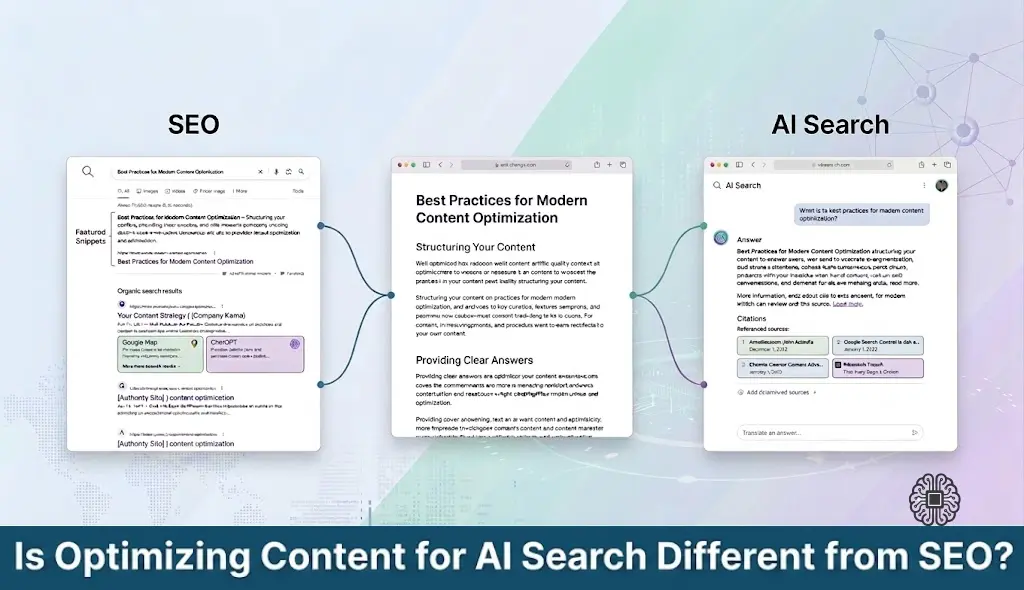
Yes, but only in a few practical areas. AI results may pull specific parts of a page to answer a question, while regular search often sends the reader to the full page.
The core work remains the same. Pages still need useful information, clear structure, reliable sources, and a strong answer to the reader’s question.
Most companies do not need a second strategy. They need to improve the pages they already have and make each section easier to understand on its own.
Why AI Search Still Relies on SEO
Google does not require a separate setup for AI Overviews or AI Mode. A page must still be crawlable, indexed, and allowed to appear with a search snippet before it can be used in those results.
Readable text, sensible internal links, a smooth page experience, and structured data that matches the visible content still matter. There is no special AI file, new schema type, or second technical system to install.
For example, a local accounting firm may publish a detailed page about tax deductions. The advice may be accurate, but Google cannot surface that content if crawling is blocked, the text stays hidden, or no other page links to it.
Good writing cannot repair poor access. SEO makes the page available, while useful information makes it worth reading.
What Traditional SEO Still Does Well
AI features have not removed the need for pages that solve real problems, show reliable knowledge, and work properly on every device. Readers still need clear answers, and search systems still need access to the information before they can use it.
SEO Practices That Still Matter
- Understand the reader’s goal: Answer what the person is trying to solve, not only the exact phrase they typed.
- Add something original: Use real experience, useful examples, research, or analysis instead of repeating common advice.
- Connect related pages: Internal links help readers continue their research and help Google find supporting content.
- Show who knows the subject: Clear authorship, relevant experience, and reliable sources make claims easier to trust.
- Keep pages accessible: Google must be able to crawl, index, and display the page in search results.
- Make reading easy: Fast loading, stable layouts, clear text, and mobile-friendly design reduce frustration.
- Correct facts when needed: Update prices, rules, dates, and product details when they change. Do not change the date simply to make old material look new.
- Stay close to the site’s purpose: Publish topics that fit the audience and the knowledge the company can genuinely offer.
These practices make a page easier to read, check, and navigate. They also give search systems a clearer picture of the subject, the source, and the value of the information.
How AI Results Use Information Differently?
AI results do not handle every query in the same way as a standard results page. They can connect related questions, pull details from several sources, and present part of the answer before someone opens a website.
Search Systems Connect Related Questions
AI results do more than look for an exact phrase. Google may run several connected searches to understand the topic, compare options, and deal with conditions hidden inside the question.
Google calls this process query fan-out. It allows AI features to explore smaller parts of a larger request and find pages that support each part of the answer.
Take this search: “Which payroll software works best for a 20-person UK company with contractors?” A weak page may define payroll software and list a few brands. That does not help the reader choose.
A stronger page covers staff limits, contractor payments, tax reports, integrations, pricing rules, and where each product falls short. It also backs important claims with clear evidence, so the reader can judge the options with confidence.
A Useful Answer May Appear Before the Visit
Traditional search often shows a list of pages and lets the reader choose where to go. AI Overviews and AI Mode can present an answer first, then link to websites that support different parts of it.
A supporting link can place a company in front of the reader, but it does not guarantee a visit. The page still needs deeper detail, proof, or practical advice that gives people a reason to continue.
SEO and AI Search – What Is the Real Difference?
The main difference is how people receive information and move from a question to a source.
| Area | Traditional Search | AI Features |
|---|---|---|
| Typical experience | The reader chooses from a list of results. | The reader may see an answer before opening a website. |
| Question type | Often handles direct searches well. | Can deal with comparisons, conditions, and follow-up questions. |
| Presentation | Shows ranked pages and other search features. | Creates a response and links to supporting sources. |
| Use of sources | One result usually leads to one full page. | Several pages may support different parts of the answer. |
| Role of context | Helps match a page with the search. | Helps connect details, choices, and related questions. |
| Technical foundation | Depends on crawling and indexing. | Uses the same basic search requirements. |
| Opportunity | Can bring rankings, visits, leads, and sales. | Can bring source mentions, visits, leads, and sales. |
The real difference sits in the search experience. Traditional results help people choose a page, while AI features may combine details from several sources before they visit one. In both cases, the source still needs accurate information, clear writing, and proper technical access.
Why One Content Strategy Can Serve Both
A separate content plan for AI results usually creates more work without solving a real problem. The audience, customer questions, and buying concerns remain the same, so one strong editorial plan can serve both regular search and AI-led results.
Consider a commercial cleaning company whose office-cleaning page already ranks locally. Creating another version labelled “for AI” would split useful information across two pages and could make both weaker.
A better option is to improve the existing page with clear pricing factors, contract terms, cleaning frequency, security procedures, service areas, and the details that affect a quote. Each section should answer one question clearly while still supporting the main service page.
That approach helps potential clients compare providers and gives search systems more useful material for detailed queries. For page-level changes, read How to Optimize Content for AI Search.
When Existing Pages Need Improvement
A company should review its content when current pages stop answering the questions customers ask during sales calls, support chats, or online searches.
- Expand weak explanations: Add detail when a section names a topic but does not help the reader understand or use it.
- Cover missing concerns: Include questions that customers raise often but the page ignores.
- Replace broad claims: Support promises with proof, limits, examples, or clear reasoning.
- Correct outdated details: Update prices, rules, features, dates, and processes when they change.
- Use stronger examples: Show how the advice works in a realistic situation.
- Link related pages: Point readers to another page when it answers the next logical question.
- Cut repeated material: Keep the clearest explanation and remove weaker versions.
- Check page access: Review crawling, indexing, visible text, and search snippet eligibility.
Not every page needs a full rewrite. Focused changes often solve the problem faster while protecting sections that already perform well.
Use the AI Search Content Optimization Checklist when reviewing existing pages.
Common Misconceptions About AI Search and SEO
| Myth | Reality |
|---|---|
| AI search has replaced SEO. | Google still recommends its established SEO practices for AI features. |
| Keywords no longer matter. | Search terms still help, but the page must answer what the person actually wants to know. |
| A number-one ranking guarantees a supporting link. | Strong rankings and technical eligibility do not guarantee inclusion in an AI response. |
| A special AI schema is required. | Google does not require a separate schema type or machine-readable AI file. |
| Every URL needs a complete rewrite. | Pages with useful information may only need focused corrections or added detail. |
Meeting Google’s requirements does not guarantee crawling, indexing, ranking, or inclusion in AI results.
What Businesses Should Take Away
Keep the SEO work that already helps people find, understand, and trust your pages. Before creating separate versions for AI results, improve the content you already have with better answers, sound evidence, clear wording, and real experience.
AI features offer another route for useful information to reach potential customers. Teams comparing research and content-review platforms can explore the Best AI Search Optimization Tools. Build on what works instead of starting from zero.
FAQ’s
Does Google require a special schema for AI Overviews?
No. Google does not require a separate schema type for AI Overviews or AI Mode. Standard structured data can still support understanding when it accurately reflects the visible page.
The page must also meet normal Search requirements, including crawl access, indexing eligibility, and permission to show a snippet. Markup cannot make an inaccessible or low-quality page eligible on its own.
Can older content appear in AI results?
Yes. Publication age alone does not decide whether a page can appear in AI results. An older page may remain useful when its facts, advice, prices, and references are still correct.
A newly dated page can be less reliable if nobody checked the underlying information. Update content when the subject changes, not simply to make the page look recent.
Can one page appear in traditional results and AI features?
Yes. One indexed page can appear in regular Google Search and may also be used as a supporting source in an AI Overview or AI Mode response. Google does not require a second version made for AI features.
Keeping one strong page also reduces duplication and makes updates easier, because readers and search systems receive the same current information.