
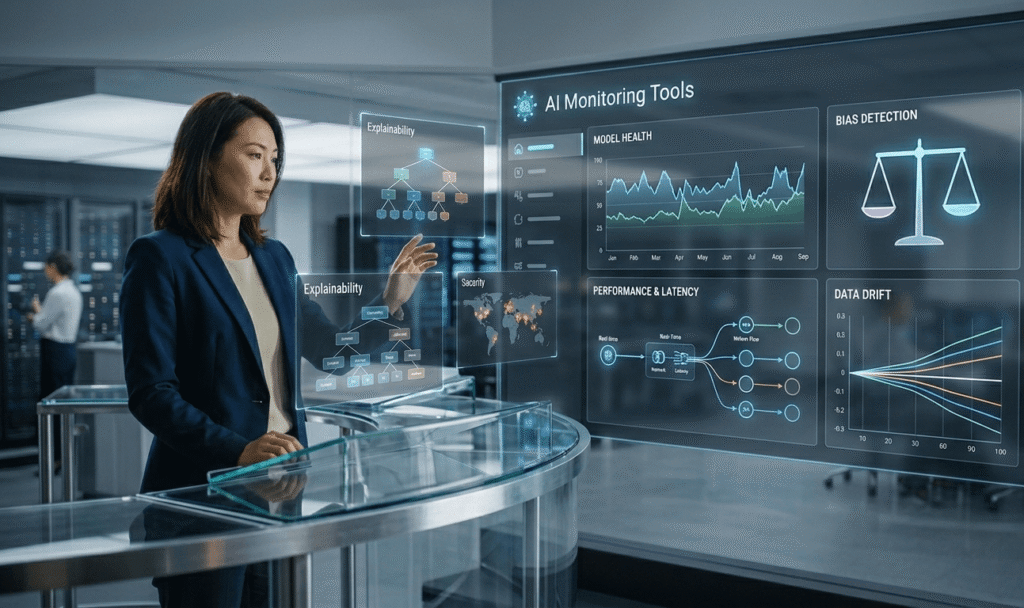
Artificial intelligence is growing very fast. Today, companies use AI for decision-making, automation, customer service, and data analysis. But as AI systems grow, they also become more complex. This is where AI monitoring tools become very important.
In this detailed guide, you will learn what AI monitoring tools are, how they work, why they matter, and how businesses use them. This article is written in simple and clear language to help beginners understand easily.
What Are AI Monitoring Tools?
AI monitoring tools are software systems that track, analyze, and manage the performance of artificial intelligence models and systems in real time.
In simple words, these tools help answer questions like:
- Is the AI working correctly?
- Is it making accurate decisions?
- Is it showing bias or errors?
- Is performance getting worse over time?
AI systems are not “set and forget.” They change over time. Data changes, user behavior changes, and models can become outdated. Monitoring tools make sure AI systems stay accurate, reliable, and safe.
Why AI Monitoring Tools Are Important
AI systems can fail without proper monitoring. Many companies have learned this the hard way.
According to research:
- 91% of machine learning models degrade over time without monitoring
- 90% of IT professionals say observability is critical, but only 26% have mature systems
This shows a big gap between understanding and actual implementation.
AI monitoring tools solve this problem by continuously checking system health and performance. Businesses that are still exploring adoption can first understand why use AI search monitoring tools and how they help maintain accuracy, reliability, and long-term system stability.
Growth of AI Monitoring Tools (Market Stats)
The demand for AI monitoring tools is growing very fast. This is because more companies are using AI in daily operations.
Market Growth Table
|
Year |
Market Size |
|
2025 |
$1.1 Billion |
|
2030 |
$3.4 Billion (projected) |
|
Growth Rate |
12.2% CAGR |
Another report shows:
- AI monitoring market could reach $39.8 billion by 2031 (Pro Market Reports)
- AI monitoring systems market was $3.25 billion in 2025 (Verified Market Research)
This rapid growth proves that monitoring is becoming essential, not optional.
How AI Monitoring Tools Work
AI monitoring tools collect and analyze data from AI systems in real time.
Basic Working Process
- Data Collection: The tool collects data from AI models, inputs, and outputs.
- Performance Tracking: It checks accuracy, speed, and errors.
- Anomaly Detection: It finds unusual patterns or failures.
- Alerts & Notifications: If something goes wrong, alerts are sent immediately.
- Reporting & Insights: Dashboards show performance trends and issues.
Types of AI Monitoring Tools
AI monitoring tools are not all the same. They focus on different areas depending on business needs.
1. Model Performance Monitoring
Tracks how well AI models are working.
2. Data Monitoring
Checks data quality and detects data drift.
3. AI Observability Tools
Provide full visibility into AI systems, similar to DevOps monitoring.
4. AI Visibility Monitoring
Tracks how AI platforms like chatbots mention brands.
For example: AI tools now track visibility in platforms like ChatGPT and search engines.
Key Features of AI Monitoring Tools
Good AI monitoring tools offer several important features:
1. Real-Time Monitoring
Tracks system performance instantly.
2. Drift Detection
Identifies when model accuracy drops.
3. Bias Detection
Ensures fairness and reduces discrimination risks.
4. Alert System
Notifies teams about issues quickly.
5. Dashboard & Reports
Shows insights in easy-to-understand visuals.
Benefits of AI Monitoring Tools
AI monitoring tools provide many advantages for businesses.
1. Better Accuracy
Monitoring helps keep AI models accurate over time.
2. Reduced Downtime
Problems are detected early, reducing system failures.
3. Improved Security
AI monitoring helps detect threats and unusual behavior.
4. Regulatory Compliance
New laws require companies to monitor AI systems.
For example: The EU AI Act (2026) requires continuous monitoring and auditing of AI systems.
Real-World Use Cases
AI monitoring tools are used in many industries.
Healthcare
- Monitor AI diagnosis systems
- Ensure patient safety
Finance
- Detect fraud
- Monitor risk models
E-commerce
- Track recommendation systems
- Monitor customer behavior
IT & Cloud Systems
- Monitor AI-powered applications
- Improve system performance
Table: Key Use Cases of AI Monitoring Tools
|
Industry |
Use Case |
Benefit |
|
Healthcare |
Patient diagnosis monitoring |
Better accuracy |
|
Finance |
Fraud detection |
Risk reduction |
|
Retail |
Product recommendations |
Increased sales |
|
IT |
System monitoring |
Improved performance |
Challenges of AI Monitoring Tools
Despite many benefits, there are some challenges.
1. High Cost
Advanced tools can be expensive for small businesses.
2. Complexity
AI systems are complex and need skilled professionals.
3. Data Privacy
Monitoring requires handling sensitive data carefully.
4. Integration Issues
Tools may not easily connect with existing systems.
Popular AI Monitoring Tools in 2026
Many tools are available today, ranging from system monitoring platforms to advanced visibility solutions. Businesses that want to compare options can explore dedicated tools for monitoring AI Overviews and search visibility to better understand which platforms fit their needs.
- Splunk
- Datadog
- IBM Watson monitoring tools
- AI visibility tools like Profound and Scrunch
These tools help businesses monitor performance, detect issues, and improve AI systems.
Future of AI Monitoring Tools
The future of AI monitoring tools looks very strong.
Key Trends
- More automation in monitoring
- Better real-time analytics
- Integration with AI agents
- Focus on explainability and ethics
Also:
- 70% of organizations increased monitoring budgets in 2025
- 75% plan to increase spending further in 2026
This shows growing importance across industries.
AI Monitoring vs Traditional Monitoring
Traditional monitoring focuses on systems like servers and applications.
AI monitoring focuses on:
- Data quality
- Model behavior
- Predictions and outputs
This makes AI monitoring more complex and advanced.
Best Practices for Using AI Monitoring Tools
To get the best results, companies should:
- Monitor models continuously
- Use multiple monitoring tools
- Update models regularly
- Train teams properly
Conclusion
AI is transforming industries, but it also brings new challenges. Without proper monitoring, AI systems can fail, become biased, or produce incorrect results.
That’s why AI monitoring tools are essential. They help businesses ensure performance, accuracy, security, and compliance.
With the market growing rapidly and regulations increasing, AI monitoring is no longer optional—it is a must-have for any company using artificial intelligence.
FAQs
What are AI monitoring tools used for?
AI monitoring tools are used to track the performance, accuracy, and behavior of AI systems in real time.
Why are AI monitoring tools important?
They help prevent errors, detect bias, and ensure AI systems work correctly over time.
Do AI models need monitoring?
Yes. Studies show that 91% of AI models degrade over time without monitoring (Zylos)
Are AI monitoring tools expensive?
Some tools can be costly, but there are also affordable options for small businesses.
What industries use AI monitoring tools?
Healthcare, finance, retail, IT, and many other industries use them.
What is the future of AI monitoring tools?
The future includes more automation, better analytics, and stronger regulatory compliance requirements.